Reviewed by the TRU Biologix Medical Team
Vegan PDRN, salmon PDRN and Lacto-PDRN are all short fragments of DNA sold under the same name, but they come from three different places: plant cell cultures, the milt of salmon or trout, and fermented Lactobacillus bacteria. Salmon PDRN is the original and by far the most studied. The vegan options, plant and Lacto-PDRN, are newer, and their research record is still mostly laboratory work.
This guide compares the three sources and shows how to tell which one a product uses. If you are new to the ingredient, start with what PDRN is and how it is used in skincare.
Key takeaways
- Salmon PDRN is extracted from salmon or trout milt and has the longest research record, going back to the 1990s.
- Vegan PDRN usually means plant PDRN from callus or cell cultures; a 2026 review describes its evidence as still mostly preclinical.
- Lacto-PDRN is DNA from fermented Lactobacillus bacteria, first reported in 2025, and is also animal-free.
- Labels can blur the source: “sodium DNA” covers every type, so check the stated origin.
What is salmon PDRN?
Salmon PDRN is the original form of the ingredient. It is extracted from the milt (sperm cells) of salmon or trout, purified, and broken into short DNA fragments. Almost all PDRN research since the 1990s has used fish-derived material, which is why it remains the reference point the newer sources are compared against.
Size is what defines it. A 2025 review proposed that DNA polymers below 1,500 kDa be called PDRN and longer chains polynucleotides (PN); we explain that split in PDRN vs polynucleotides. In a 2025 laboratory comparison, salmon PDRN fragments measured roughly 200 to 800 base pairs.
What is vegan (plant) PDRN?
Vegan PDRN usually means plant PDRN, also marketed as phyto-PDRN: DNA extracted from plant material grown in the lab, such as callus (a mass of undifferentiated plant cells), adventitious roots or plant cell cultures. Published examples include preparations from peony (Paeonia lactiflora) callus and snow lotus (Saussurea involucrata). Lacto-PDRN, below, is animal-free too, so “vegan PDRN” on a label can mean either source.
In cell studies, researchers have reported activity that overlaps with salmon PDRN. A 2026 review of plant-derived PN and PDRN is careful about what that means: the evidence is still predominantly preclinical, it should not be read as clinical equivalence to fish-derived PDRN, and direct head-to-head comparisons are limited. The review also flags quality questions specific to plant sources, such as RNA carryover and leftover plant compounds, which can make it hard to tell what is actually responsible for a result.

What is Lacto-PDRN?
Lacto-PDRN is DNA taken from Lactobacillus bacteria grown by fermentation. The first published report, in 2025, extracted it from Lactobacillus rhamnosus. In that laboratory study the bacterial DNA fragments were under 100 base pairs, much shorter than the salmon PDRN it was compared with.
The term reached the mass market in 2026, when The Ordinary launched an eye cream built on Lacto-PDRN made by fermenting L. rhamnosus. Its ingredient list shows Lactobacillus ferment alongside sodium DNA.
Names can mislead in both directions. A 2026 case series on a serum sold as “phyto PDRN” describes its PDRN as coming from a bacterium, Lactobacillus sakei, rather than from a plant.
Vegan vs salmon vs Lacto-PDRN compared
The three share a name and, often, an ingredient-list entry. They differ in origin, fragment size and how much research stands behind them.
| Salmon PDRN | Plant (vegan) PDRN | Lacto-PDRN | |
|---|---|---|---|
| Source | Salmon or trout milt | Plant callus, roots or cell cultures | Lactobacillus bacteria |
| How it is made | Extraction and purification of fish DNA | Extraction from lab-grown plant cells | Fermentation, then DNA extraction |
| Animal-free | No | Yes | Yes |
| Fragment size | Roughly 200–800 base pairs in one 2025 comparison | Varies by process; not yet standardised | Under 100 base pairs in the first 2025 report |
| Research record | Decades, since the 1990s | Recent and mostly preclinical | First reported in 2025 |
| Typical label entry | Sodium DNA | Sodium DNA or a plant-specific name | Lactobacillus ferment, sodium DNA |
Fragment sizes come from single laboratory studies and vary between suppliers.
Is vegan PDRN as good as salmon PDRN?
Nobody can say yet. There are no published head-to-head studies comparing the three at matched concentration, molecular size and purity, and the evidence for plant and bacterial PDRN is still mostly from laboratory cell work. Early lab results are encouraging, but a cell study is not a comparison of finished skincare products on skin.
That does not make the newer sources a poor choice. For patients who avoid animal-derived ingredients, an animal-free PDRN is a legitimate reason to pick one product over another. It simply means the choice should rest on the source, the formula and the brand’s transparency, rather than on an assumption that every PDRN behaves the same.
How to tell which PDRN a product uses
- Read beyond “sodium DNA”. It is the standard ingredient name for purified DNA from any source, so on its own it does not tell you where the DNA came from.
- Look at neighbouring ingredients. “Lactobacillus ferment” listed next to sodium DNA usually points to a fermentation source.
- Check the stated origin. Reputable brands say whether their PDRN is salmon, plant or fermentation-derived. Read “phyto” or “vegan” in a product name as a claim to confirm with the brand.
- Ask about molecular size. Professional suppliers should be able to say whether the material is PDRN or PN and roughly how large the fragments are.
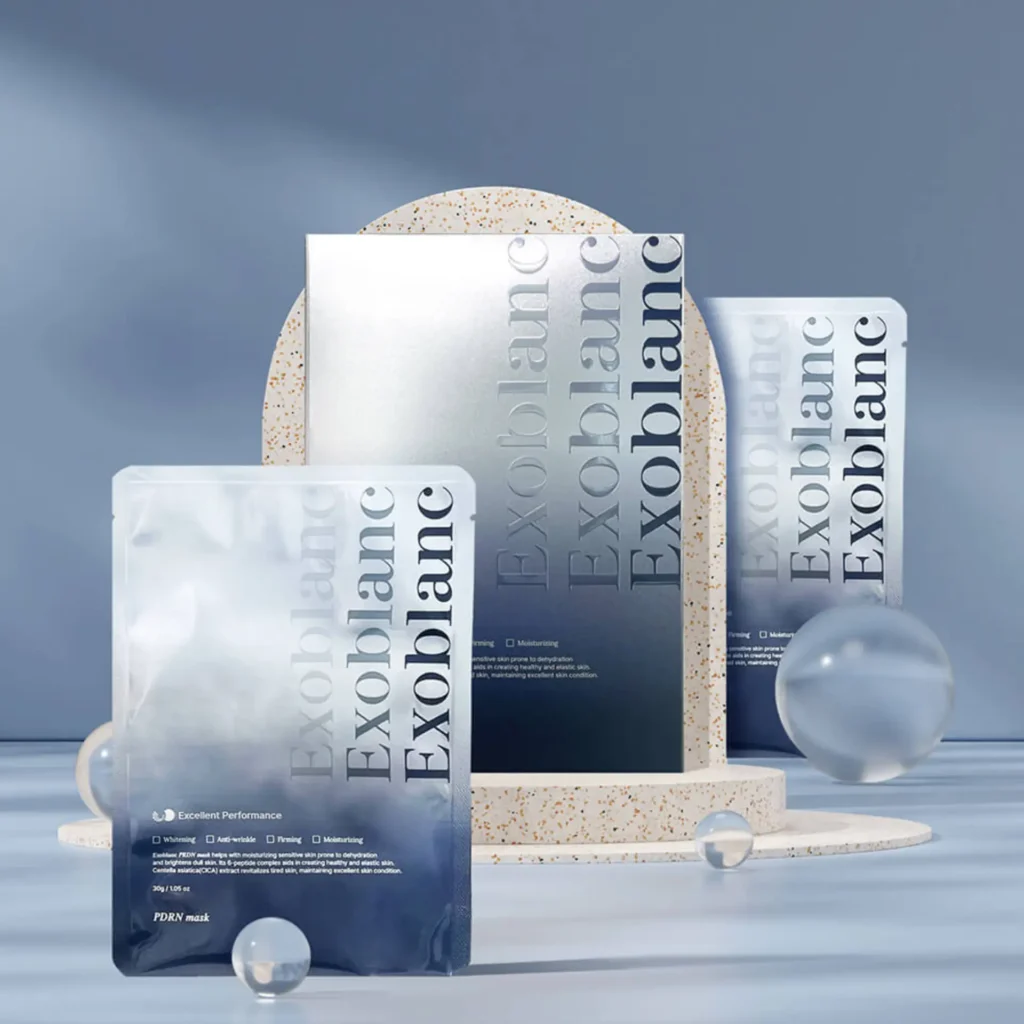
For reference, the PDRN in the Exoblanc line is salmon-derived and listed as sodium DNA. It appears in the PDRN Boosting Serum, the PDRN Boosting Cream and the PDRN Mask. Whatever the source, topical PDRN is a large molecule that works at the surface and in the upper layers of the skin, which is why formulation and delivery matter as much as origin.
Products in this article
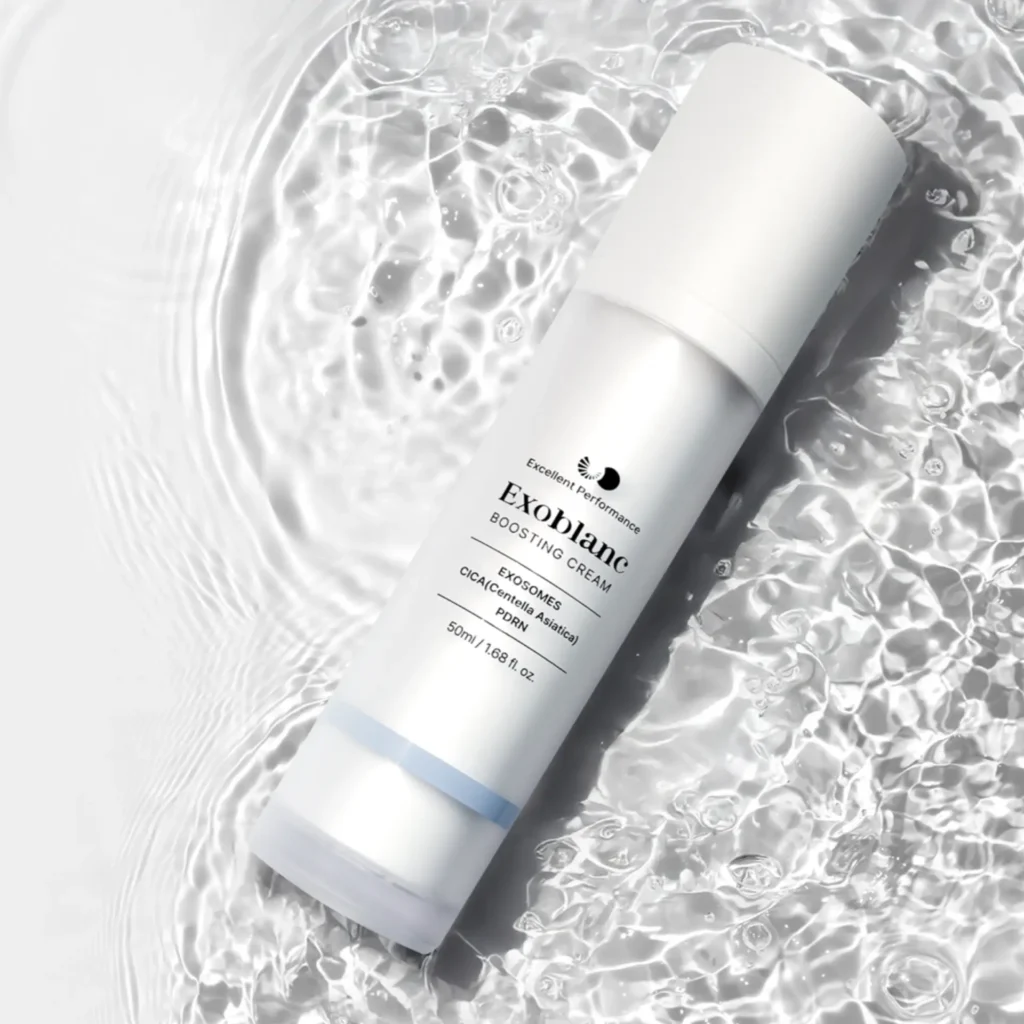
Exoblanc PDRN Boosting Cream
Daily cream with salmon-derived PDRN, rose callus vesicles and EGF for skin that looks and feels hydrated.

Exoblanc PDRN Boosting Serum
Lightweight serum with salmon-derived PDRN and hyaluronic agents for dehydrated or combination skin.
Frequently asked questions
What is the difference between vegan PDRN and salmon PDRN?
Salmon PDRN is DNA extracted from salmon or trout milt and has decades of research behind it. Vegan PDRN is usually DNA extracted from lab-grown plant cells such as callus, or from fermented bacteria; it is animal-free, but its evidence is still mostly from laboratory studies.
What is Lacto-PDRN?
Lacto-PDRN is DNA extracted from Lactobacillus bacteria grown by fermentation. It was first reported in 2025 using Lactobacillus rhamnosus and is now used in some retail skincare as an animal-free PDRN.
Is vegan PDRN real PDRN?
Yes, in the sense that it is also made of short DNA fragments. PDRN is defined by its structure and size rather than its source, but plant and bacterial PDRN have a much shorter research record than salmon PDRN.
Is vegan PDRN as effective as salmon PDRN?
There is not enough evidence to say. No published studies compare the sources head to head at matched concentration and size, and most plant PDRN data come from cell studies.
How can I tell where the PDRN in a product comes from?
Sodium DNA on the label covers every source, so check the brand’s stated origin. Lactobacillus ferment listed next to sodium DNA usually indicates fermentation-derived PDRN.
Is Exoblanc PDRN salmon or plant-based?
The PDRN in the Exoblanc line is salmon-derived and appears on the ingredient list as sodium DNA.
References
- Marques C, Porcello A, Cerrano M, et al. From polydeoxyribonucleotides (PDRNs) to polynucleotides (PNs): bridging the gap between scientific definitions, molecular insights, and clinical applications of multifunctional biomolecules. Biomolecules 2025;15(1):148. doi:10.3390/biom15010148
- Kim HJ, Lee JW, Kim S, Son KH. Plant-derived polynucleotides/polydeoxyribonucleotides in skin biomaterials: delivery platforms and bioactivity attribution. J Funct Biomater 2026;17(7):351. doi:10.3390/jfb17070351
- Chae D, Oh SW, Choi YS, et al. First report on microbial-derived polydeoxyribonucleotide: a sustainable and enhanced alternative to salmon-based polydeoxyribonucleotide. Curr Issues Mol Biol 2025;47(1):41. doi:10.3390/cimb47010041
- Hwang S, Park S, Lee JW, et al. Paeonia lactiflora callus-derived polynucleotides enhance collagen accumulation in human dermal fibroblasts. J Funct Biomater 2026;17(1):56. doi:10.3390/jfb17010056
- Kim DJ, Bak SU, Lee SY, et al. Skin regenerative potential of polydeoxyribonucleotide isolated from Saussurea involucrata. Cell Mol Biol (Noisy-le-grand) 2025;71(11):94–99. doi:10.14715/cmb/2025.71.11.12
- Wu Y, Guénin S, Fung E, et al. Real-world cases using phyto polydeoxyribonucleotide (PDRN) serum. J Drugs Dermatol 2026;25(9). doi:10.36849/jdd.15491
- The Ordinary. Introducing Lacto-PDRN 4% + B9 Eye Cream (brand information, 2026).
- Manufacturer data, Exoblanc PDRN Boosting Serum, PDRN Boosting Cream and PDRN Mask: PDRN source and ingredient listing.