Reviewed by the TRU Biologix Medical Team
An eye cream for dark circles works best when the darkness comes from dry, thin-looking or dull skin, and least when it comes from the shape of the face. The ingredients with the most support for the look of the eye area are niacinamide and vitamin C for brightness, hyaluronic acid and glycerin for the crepey, shadowed look of dehydration, caffeine for a temporarily less puffy look, and peptides and NAD+-family ingredients such as NMN for smoother, firmer-looking skin. This guide sorts the under-eye concerns, matches them to ingredients, and is honest about the limits.
Key takeaways
- Dark circles are usually a mix of three things: dull or uneven-looking tone, thin, dry skin that lets colour show through, and shadow from the shape of the eye area.
- Eye cream can help the first two; it cannot change the third.
- Niacinamide and vitamin C address the look of tone; hyaluronic acid, glycerin and ceramides address dryness; peptides and NMN address the look of firmness.
- Apply a rice-grain amount with the ring finger, before moisturiser, morning and night, and give it eight to twelve weeks.
What makes the under-eye area look dark?
Before choosing an ingredient, work out which kind of darkness you are looking at. A comprehensive review in the Journal of Clinical and Aesthetic Dermatology groups the causes into a few recognisable patterns, and the same patterns decide what topical care can do.
Brownish, uneven-looking tone.
Looks darker in daylight and does not change much when you gently stretch the skin. Brightening ingredients such as niacinamide and vitamin C are the fit, with daily sunscreen.
Bluish or purplish shadow through thin, dry skin.
Fades when the skin is gently stretched or when you are well rested and hydrated. Hydrating and barrier-supporting ingredients make the skin look less translucent; firming-look ingredients help over time.
Shadow from hollowness or puffiness.
Changes with the angle of the light and is really a contour, not a colour. No cream changes the contour; caffeine can make puffiness look less pronounced for a few hours, and a licensed provider can advise on in-office options.
Most people have a mix, which is why a good eye cream for dark circles combines a brightening ingredient, a hydrating ingredient and a firming-look ingredient rather than relying on one.
Eye cream ingredients for dark circles: the scorecard
What each ingredient does for the look of the eye area, and how strong the evidence is.
| Ingredient | What it does for the look | Evidence | Notes |
|---|---|---|---|
| Niacinamide | Evens the look of tone; softens the look of fine lines | Clinical cosmetic studies on facial skin | Well tolerated near the eyes at 2–5% |
| Vitamin C | Brightens the look of dull, uneven tone | Established antioxidant; eye-area data limited | Choose a stable, low-irritation form |
| Hyaluronic acid | Plumps the look of crepey, dehydrated skin | Established humectant | Needs a cream on top to hold water in |
| Ceramides / glycerin | Supports the feel of a comfortable, sealed barrier | Established | The base of most good eye creams |
| Caffeine | Temporarily reduces the look of puffiness | Modest; short-lived effect | Morning use; effect is hours, not weeks |
| Peptides | Smoother, firmer-looking eye contour over time | Cosmetic studies; varies by peptide | Pairs with niacinamide |
| NMN / NAD+ family | Fresher, less tired-looking skin | Early laboratory research | Read our NAD+ guide for the science |
| Plant exosomes | Skin-conditioning; often paired with peptides | In-vitro so far | A supporting ingredient, not a lead |
| Retinoids | Smoother-looking texture over months | Strong for face; eye area is sensitive | Start slowly; many people cannot tolerate daily |
Evidence refers to published cosmetic and laboratory research on the ingredient, not to any specific product.
Why NMN and niacinamide show up in the same eye cream
NMN (nicotinamide mononucleotide) and niacinamide are cousins. Both belong to the vitamin B3 family and both feed into the skin’s NAD+ pool. Niacinamide has decades of cosmetic data for the look of tone and texture; NMN is newer, with laboratory research suggesting it supports the look of the skin’s moisture barrier and resilience in cell and animal models. Putting them together covers the proven and the promising in one step.
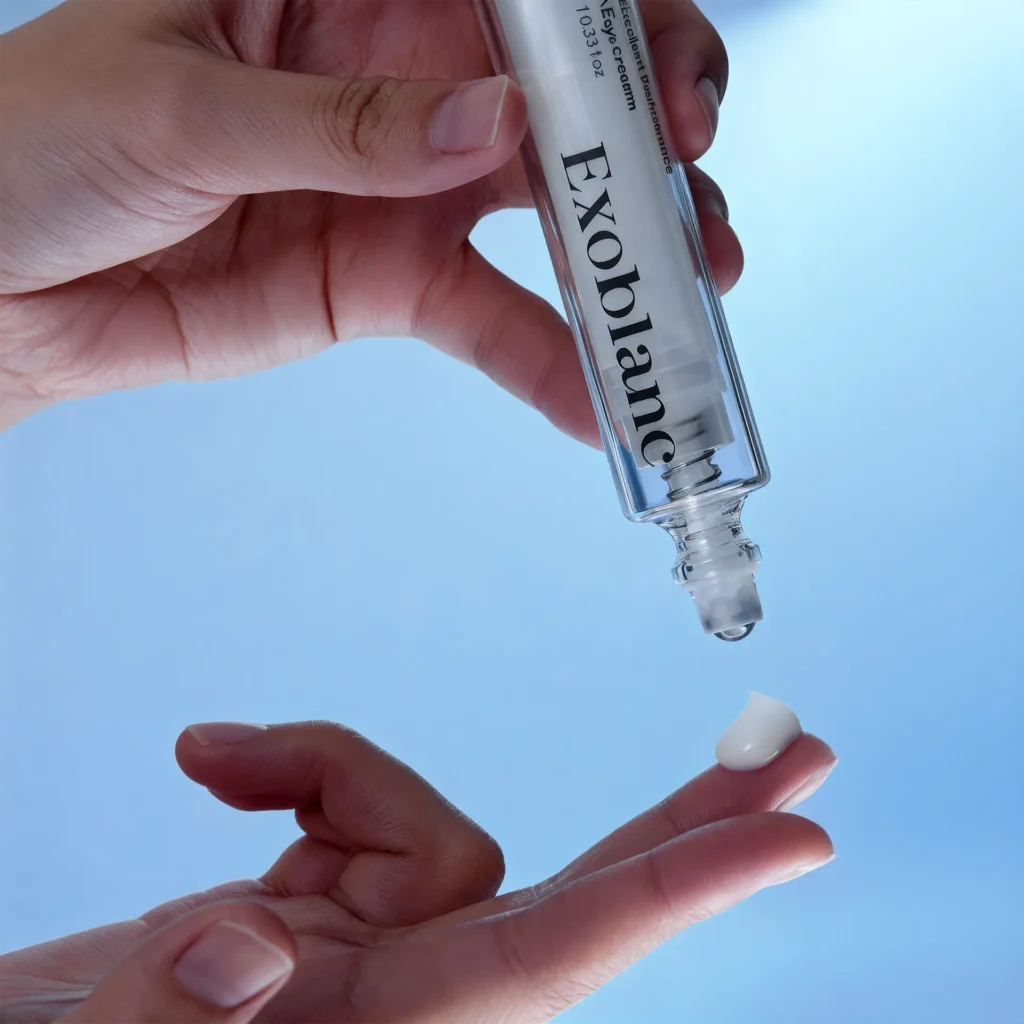
Exoblanc’s NMN Eye Cream is built this way: NMN and niacinamide for a brighter, fresher look, peptides for a firmer-looking contour, and plant exosomes as a conditioning partner. It is a topical cosmetic for beautification purposes only. For how NMN, NAD+ and niacinamide relate, read what NAD+ does in skincare; for the exosome part, see what plant exosomes are.

How to apply eye cream for dark circles
- Use less than you think. A rice-grain amount covers both eyes. More product migrates into the eyes and can make the area look puffy.
- Dot, then pat. Place small dots along the orbital bone, from the inner corner outward, and pat with the ring finger. No dragging.
- Order: after serums, before moisturiser and sunscreen. The eye area should get its own product, not a diluted layer of face cream.
- Morning and evening. Caffeine-led formulas are most useful in the morning; richer, peptide-led formulas suit the evening.
- Sunscreen to the lash line. Uneven-looking tone under the eyes is made worse by sun; a mineral sunscreen is usually the most comfortable choice there.
- Give it time. Hydration shows within days; changes in the look of tone and firmness take eight to twelve weeks of consistent use.
What eye cream cannot do
The honest list, because expectations decide whether a product feels like it worked.
- It cannot change the contour. Hollowness and the shadow it casts are structural. Lighting, sleep position and hydration shift the look slightly; no topical changes the shape.
- It cannot undo a short night. Caffeine and a cold applicator help the look for a few hours. Sleep, hydration and limiting salt and alcohol do more than any cream.
- It cannot replace sun protection. Brightening ingredients work slowly; unprotected sun exposure works faster in the other direction.
- It is not a substitute for a professional opinion. Dark circles that appeared suddenly, affect one eye only, or come with swelling or itching deserve a visit to a licensed provider rather than a new product.
Within those limits, a well-chosen eye cream does make a visible difference to tone, hydration and the look of fine lines, and that is usually enough to make the area look rested.
Choosing an eye cream: a quick checklist
One brightening ingredient (niacinamide or vitamin C) · one hydrator (hyaluronic acid or glycerin) · barrier lipids (ceramides) · optionally peptides or NMN for the look of firmness · fragrance-free · a pump or tube rather than an open jar.
Building an under-eye routine
A simple two-step approach works for most people: a brightening and firming-look eye cream morning and night, and a hydrating, barrier-supporting face moisturiser carried gently up to the orbital bone on top. In the Exoblanc range that pairing is NMN Eye Cream followed by Skin Barrier Cream. If you also use a vitamin C oil or a ceramide oil on the face, keep it below the orbital bone; the eye area rarely needs an oil on top of an eye cream. For how ceramides, niacinamide and hyaluronic acid divide the work, see ceramides vs niacinamide vs hyaluronic acid.
For how a provider builds the full Exoblanc routine around the eye area and the face, watch the Exoblanc routine webinar with Micaela Irvin, FNP-C.
Products in this article

Exoblanc NMN Eye Cream
NMN, niacinamide, peptides and plant exosomes for a brighter, firmer-looking eye area.
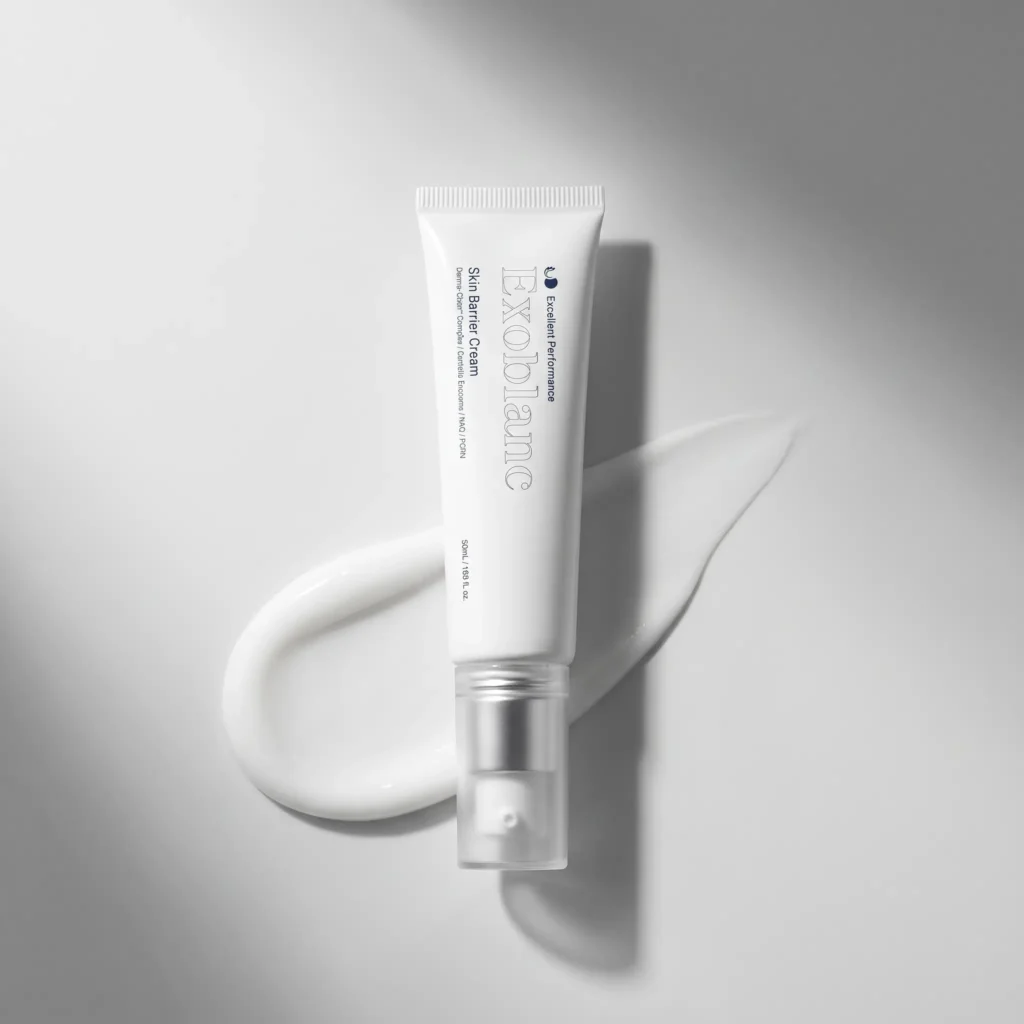
Exoblanc Skin Barrier Cream
Hyaluronic acid, panthenol and glycerin moisturiser to seal hydration in around the eye area.
Frequently asked questions
Does eye cream actually help dark circles?
It helps when the darkness comes from dull or uneven-looking tone or from dry, thin-looking skin. It does not change shadows caused by the shape of the eye area. Most people have a mix, so a combined brightening and hydrating formula usually makes a visible difference.
What is the best ingredient in eye cream for dark circles?
Niacinamide has the most cosmetic evidence for the look of tone, with vitamin C close behind. Pair either with hyaluronic acid for hydration and peptides or NMN for the look of firmness.
What eye cream is good for dark circles and puffiness?
Look for caffeine for a less puffy look in the morning, plus niacinamide or vitamin C for tone. Keep the formula light and fragrance-free, and store it in a cool place for a stronger de-puffing feel.
How long does eye cream take to work on dark circles?
Hydration shows within days. Changes in the look of tone and fine lines usually take eight to twelve weeks of twice-daily use.
Can I use face moisturiser instead of eye cream?
You can, but eye creams are formulated to be lighter, fragrance-free and less likely to migrate into the eyes. If you use a face cream, choose a gentle one and apply a small amount.
Does NMN help dark circles?
NMN belongs to the vitamin B3 family, like niacinamide. Laboratory research suggests it supports the look of the skin barrier; in eye creams it is used alongside niacinamide and peptides for a fresher, firmer-looking eye area rather than as a stand-alone brightener.
References
- Sarkar R, Ranjan R, Garg S, Garg VK, Sonthalia S, Bansal S. Periorbital hyperpigmentation: a comprehensive review. J Clin Aesthet Dermatol 2016;9(1):49-55.
- Bissett DL, Oblong JE, Berge CA. Niacinamide: a B vitamin that improves aging facial skin appearance. Dermatol Surg 2005;31(7 Pt 2):860-865.
- Papakonstantinou E, Roth M, Karakiulakis G. Hyaluronic acid: a key molecule in skin aging. Dermatoendocrinol 2012;4(3):253-258.
- Kim SJ, Lee S, Choi YJ, et al. β-Nicotinamide mononucleotide enhances skin barrier function and attenuates UV-B-induced photoaging in mice. Antioxidants (Basel) 2025;14(12):1424.
- Hughes MC, Williams GM, Baker P, Green AC. Sunscreen and prevention of skin aging: a randomized trial. Ann Intern Med 2013;158(11):781-790.